
Real estate has long been considered one of the most stable asset classes. However, traditional property investments come with significant barriers: high capital requirements, limited liquidity, complex legal structures, and restricted access for many investors.
Tokenized real estate aims to change this. By combining physical real estate with blockchain technology, properties can be divided into digital tokens that represent ownership or economic rights. This allows investors to participate in real estate projects with smaller amounts of capital while gaining increased transparency and, in some cases, improved liquidity.
In this guide, you will learn what tokenized real estate is, how it works in practice, what benefits and risks it involves and whether this emerging investment model may be suitable for you as an investor.
What Is Tokenized Real Estate
Tokenized real estate refers to the process of converting ownership rights or economic interests in a real-world property into digital tokens on a blockchain. Each token represents a fraction of the underlying real estate asset and can be bought, sold, or held by investors according to the rules defined in the project structure.
At its core, tokenization bridges the gap between physical real estate and digital finance. The property itself remains a tangible asset, such as commercial property, a residential building, or a development project. What changes, is the way ownership or participation rights are recorded, transferred, and managed.
Instead of relying solely on traditional legal paperwork and intermediaries, tokenized real estate uses blockchain technology to issue and track tokens. These tokens can represent different types of rights, such as profit participation, rental income, or in some cases, direct ownership shares, depending on the legal and regulatory framework.
The main idea behind tokenized real estate is accessibility. By dividing a property into smaller digital units, investors no longer need to purchase an entire building or invest large sums of capital. This opens real estate investing to a broader audience while maintaining a clear link to a real, income-generating asset.
How Tokenized Real Estate Works
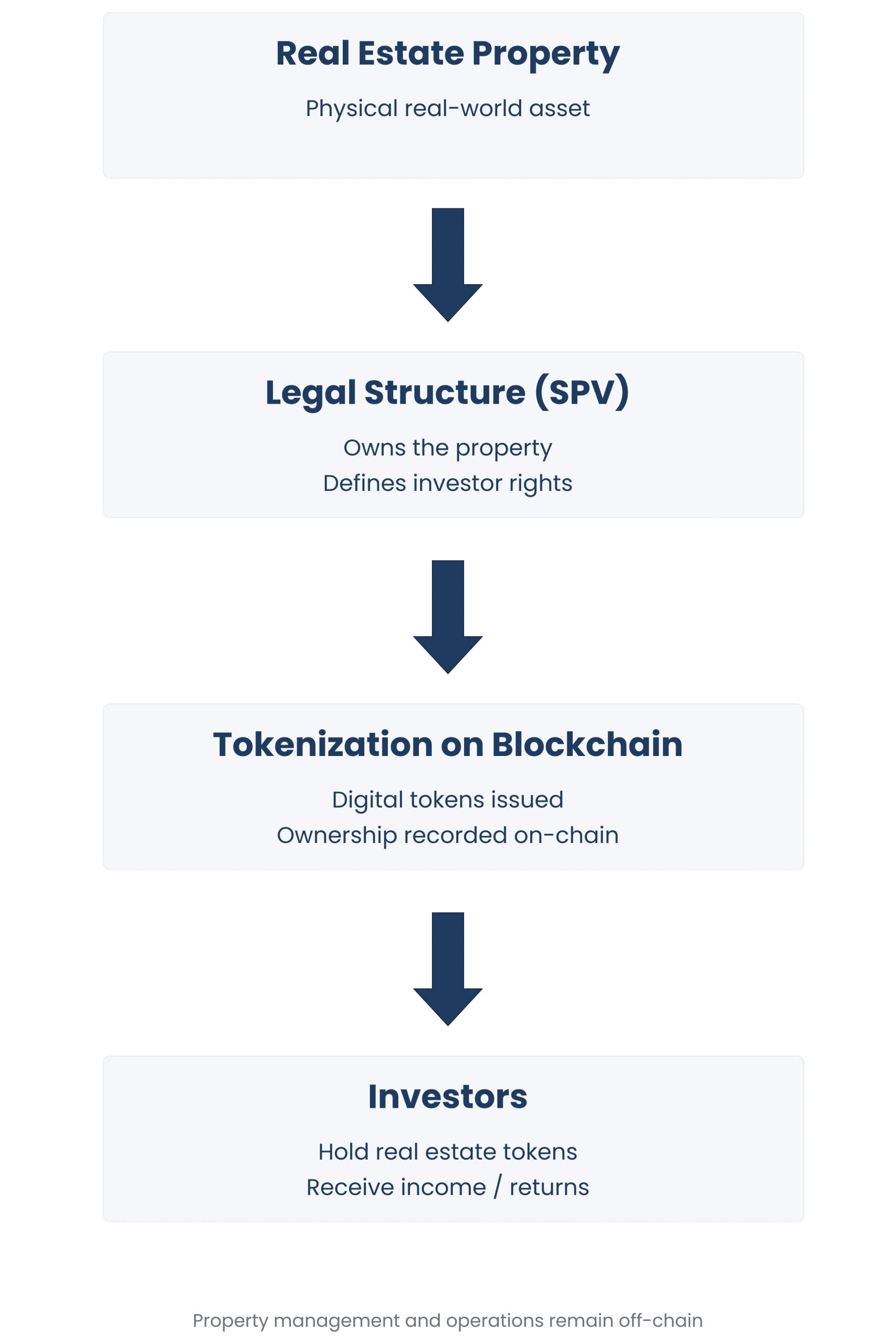
The Underlying Property
Every tokenized real estate project starts with a physical property. This can be a residential building, a commercial property, or a real estate development project. The property itself remains a tangible asset located in the real world and is typically owned or controlled by a legal entity, created specifically for the project.
The value of the tokens is directly linked to this underlying asset. Factors such as location, rental income, operating costs, and market conditions continue to determine the economic performance of the investment, just as they do in traditional real estate.
The Legal Structure Behind Tokenization
To make tokenization legally compliant, most projects use a special-purpose vehicle (SPV) or a similar legal structure. This entity holds the property and defines the rights associated with the tokens.
Investors usually do not own the property directly. Instead, they hold tokens that represent economic rights, such as a share in rental income, profits from a sale, or other contractual claims. The exact structure depends on local regulations and determines whether the tokens are classified as securities.
Token Issuance and Ownership Representation
Once the legal framework is established, digital tokens are issued on a blockchain. Each token represents a fraction of the overall investment and is assigned to investors based on their contribution.
These tokens serve as a digital record of ownership or participation rights. Because they are recorded on a blockchain, ownership transfers can be tracked transparently, and transactions can be executed according to predefined rules without relying on manual paperwork.
The Role of Blockchain and Smart Contracts
Blockchain technology provides the technical infrastructure that enables tokenized real estate. It ensures that token ownership records are immutable, transparent, and verifiable by all participants.
Smart contracts automate key processes such as token distribution, profit allocation, and, in some cases, secondary market transactions. This reduces the need for intermediaries and can lower operational costs while increasing efficiency and transparency.
Investor Access and Ongoing Management
Investors typically access tokenized real estate through specialized platforms. These platforms handle onboarding processes such as identity verification (KYC) and offer dashboards for the administration of token assets.
Ongoing management of the property, including maintenance, tenant relations, and financial reporting, is usually handled by professional real estate managers. Token holders receive regular updates and, depending on the structure, periodic income distributions linked to the performance of the underlying asset.
What Are Real Estate Tokens
Real estate tokens are digital representations of rights linked to a physical property. These tokens are issued on a blockchain and serve as proof that an investor holds a defined economic interest in a real estate project. Depending on the structure, a token can represent participation in rental income, profit-sharing, or other financial rights connected to the underlying property.
In most cases, real estate tokens do not represent direct ownership of the property itself. Instead, they grant contractual or economic rights that are legally defined within the project’s structure. This distinction is important, as it determines how investors benefit from the investment and how the tokens are regulated under financial laws.
From a technical perspective, real estate tokens are typically classified as security tokens. This means they are subject to securities regulations and must comply with legal requirements such as investor disclosures, compliance checks, and transfer restrictions. These regulations are designed to protect investors and ensure transparency within the tokenized real estate market.
Each token is recorded on a blockchain, which allows ownership to be tracked accurately and transparently. When tokens are transferred between investors, the blockchain updates the ownership record automatically. This digital infrastructure reduces reliance on manual record keeping and simplifies the process of managing fractional real estate investments.
Ultimately, real estate tokens function as the bridge between traditional real estate and digital financial markets. They enable real-world properties to be accessed, managed, and transferred in a more flexible and scalable way, while still being anchored to a tangible, income generating asset.
Fractional Ownership Explained
Fractional ownership refers to a model in which a real estate asset is divided into smaller units, allowing multiple investors to participate in the same property. Instead of purchasing an entire building or committing large amounts of capital, investors acquire a fraction of the asset that corresponds to their investment size.
In traditional real estate, fractional ownership is usually complex and administratively burdensome. It often involves joint ownership agreements, notarial processes, and limited flexibility when one investor wants to exit the investment. Tokenized real estate simplifies this model by representing fractional ownership through digital tokens on a blockchain.
Each token corresponds to a predefined share of the investment and carries specific economic rights, such as participation in rental income or profits from a future sale. Because these rights are digitally recorded, fractional ownership becomes easier to manage, transfer, and track compared to conventional co-ownership structures.
One of the key advantages of token-based fractional ownership is accessibility. Investors can gain exposure to high-value properties with significantly lower minimum investments. This opens the real estate market to a broader range of participants while enabling better diversification across multiple properties rather than concentrating capital in a single asset.
Fractional ownership through tokenization does not change the fundamental economics of real estate. The underlying asset still generates income and is subject to market conditions. What changes is the way investors access and manage their participation, making real estate investment more flexible and scalable without altering its core characteristics.
Tokenized Real Estate vs Traditional Property Investment
Tokenized real estate and traditional property investment are based on the same underlying asset class, but they differ significantly in terms of accessibility, structure, and flexibility. Traditional real estate investing typically requires substantial capital, long-term commitments, and complex legal processes. In contrast, tokenization aims to lower entry barriers and simplify participation.
| Aspect | Traditional Real Estate | Tokenized Real Estate |
|---|---|---|
| Minimum Investment | High capital needed | Lower entry through fractional tokens |
| Accessibility | Often limited by capital and location | Broader access for a wider investor base |
| Liquidity | Low, transactions are slow and complex | Potentially higher, depending on market structure |
| Transaction Process | Manual, legal-heavy, time-consuming | Digitally enabled, faster settlement |
| Clarity | Relies on third parties and reports | Ownership recorded on blockchain |
| Diversifying | Capital often focused in few assets | Easier spreading across multiple projects |
| Investor Role | May require active control | Mostly passive involvement |
One of the most notable differences is the minimum investment size. Traditional property investments often require investors to purchase an entire property or commit large sums through joint ventures or funds. Tokenized real estate allows investors to gain exposure with smaller amounts of capital by purchasing fractionalized tokens.
Liquidity is another key distinction. Traditional real estate transactions are time-consuming and illiquid, often taking months to complete. While tokenized real estate is not fully liquid, it may offer improved transferability through secondary markets, depending on regulatory and platform conditions.
Transparency and accessibility also differ. Traditional investments rely heavily on intermediaries, paperwork, and manual reporting. Tokenized real estate uses blockchain-based records, which can provide clearer ownership tracking and more standardized reporting. This can make it easier for investors to understand their position and monitor performance.
Despite these differences, both models remain subject to the same fundamental market forces. Property values, rental income, and economic conditions continue to determine returns. Tokenization does not eliminate real estate risks but changes how investors access and manage their exposure to this asset class.
Benefits of Tokenized Real Estate
Tokenized real estate offers several potential advantages compared to traditional property investments, particularly in terms of accessibility and flexibility. One of the most significant benefits is the lower minimum investment. By dividing a property into digital tokens, investors can participate with smaller amounts of capital, making real estate accessible to a wider audience.
Another key benefit is improved diversification. Instead of allocating a large portion of capital to a single property, investors can spread their investments across multiple tokenized projects in different locations or asset types. This can help reduce concentration risk within a real estate portfolio.
Transparency is also often cited as an advantage of tokenized real estate. Blockchain-based records allow ownership and transactions to be tracked in a clear and verifiable manner. Investors may benefit from more standardized reporting and clearer insight into how their investment is structured and managed.
Operational efficiency can improve through automation. Smart contracts can streamline processes such as profit distribution or ownership transfers, potentially reducing administrative complexity and costs. While this does not eliminate all intermediaries, it can make certain aspects of real estate investing more efficient.
Finally, tokenized real estate may offer increased flexibility compared to traditional ownership models. Depending on the platform and regulatory environment, investors may be able to transfer or sell tokens more easily than selling an entire property, although liquidity remains limited and should not be overestimated.
Risks and Limitations
Despite its potential benefits, tokenized real estate also involves a number of risks and limitations that investors should carefully consider. One of the most significant risks is regulatory uncertainty. Legal frameworks for tokenized assets differ widely between jurisdictions and may change over time, which can affect how tokens are issued, traded, or taxed.
Platform risk is another important factor. Investors typically rely on specialized platforms to access tokenized real estate projects. If a platform faces financial difficulties, operational issues, or shuts down entirely, investors may encounter challenges related to access, liquidity, or ongoing management, even if the underlying property remains intact.
Liquidity is often overstated in discussions about tokenized real estate. While tokens may be more transferable than traditional property shares, secondary markets are still limited in many cases. Selling tokens quickly or at a desired price may not always be possible, especially during periods of low market activity.
There are also technological risks to consider. Smart contracts and blockchain infrastructure are generally robust but not immune to errors, vulnerabilities, or unforeseen failures. Technical issues could disrupt token transfers, income distributions, or access to investment records.
Finally, tokenized real estate remains exposed to traditional real estate risks. Property values can decline, rental income may fluctuate, and economic conditions can impact returns. Tokenization changes the investment structure, not the underlying market dynamics.
Who Is Tokenized Real Estate Suitable For?
Tokenized real estate can be suitable for different types of investors, depending on their goals, risk tolerance, and level of experience. It is particularly attractive to investors who want exposure to real estate but are unable or unwilling to commit large amounts of capital to traditional property investments.
For retail investors, tokenization can provide access to real estate projects that would otherwise be out of reach. Lower minimum investments and fractional ownership allow for broader participation and easier diversification across multiple properties or regions.
Crypto-native investors may also find tokenized real estate appealing as it connects digital assets with real-world value. For this group, tokenized real estate can serve as a way to diversify away from purely digital assets while remaining within a blockchain-based investment environment.
Traditional real estate investors may use tokenized real estate as a complementary investment. It can offer exposure to specific projects or markets without the operational responsibilities associated with direct property ownership. However, such investors should carefully assess legal structures and platform reliability.
Tokenized real estate is generally less suitable for investors seeking short-term speculation or guaranteed liquidity. It is best approached as a long-term investment that combines elements of real estate and digital finance, with risks and time horizons similar to traditional property markets.
How to Get Started With Tokenized Real Estate
Getting started with tokenized real estate typically involves a few straightforward steps, although the exact process may vary depending on the platform and jurisdiction. The first step is choosing a reputable tokenization platform that offers access to real estate projects aligned with your investment goals and regulatory requirements.
Once a platform is selected, investors usually need to complete an identity verification process (KYC). This is a standard compliance requirement and helps ensure that tokenized real estate offerings meet legal and regulatory standards. After verification, investors can review available projects, including information on the underlying property, expected returns, fees, and risk factors.
Investments are typically made by purchasing tokens directly through the platform. These tokens are then stored in a digital wallet, either hosted by the platform or managed independently, depending on the setup. Investors should understand how custody works and what level of control they have over their tokens.
After investing, ongoing participation is largely passive. Investors receive updates on property performance and, where applicable, periodic income distributions. As with any real estate investment, it is important to review project documentation carefully and consider tokenized real estate as part of a broader, diversified investment strategy.
complete guide to tokenized real estate
Tokenized Real Estate and Regulation (Brief Overview)
Regulation plays a central role in tokenized real estate, as these investments typically fall under existing financial and securities laws. In many jurisdictions, real estate tokens are classified as security tokens, meaning issuers and platforms must comply with regulations related to investor protection, disclosures, and licensing.
The regulatory environment for tokenized real estate varies by region. Some countries have established clearer frameworks for digital securities, while others are still in the process of defining how tokenized assets should be treated. As a result, the legal structure, investor rights, and transferability of tokens can differ significantly depending on the jurisdiction.
For investors, regulation is a double-edged sword. On one hand, it can increase transparency and protection. On the other hand, regulatory complexity may limit liquidity, restrict who can invest, or affect how tokens can be traded. Understanding the regulatory context of a project is therefore essential prior to investing.
Final Thoughts
Tokenized real estate represents an evolving approach to property investment that combines traditional real estate with blockchain based infrastructure. It offers improved accessibility, potential efficiency gains, and new ways for investors to participate in real-world assets.
At the same time, tokenized real estate is not without risks. Regulatory uncertainty, platform dependency, and limited liquidity remain important considerations. Tokenization changes how investors access real estate, but it does not eliminate the fundamental risks associated with property markets.
For long-term investors who perform thorough due diligence, tokenized real estate may serve as a complementary component of a diversified investment portfolio. As the market matures, clarity around regulation, infrastructure, and best practices will be key to its broader adoption.